Elevate Bottle
Bottle scratches are more than a cosmetic defect. They can signal poor handling, weaken brand perception, and hide early surface damage. The global packaging industry continues to favor lightweight, recyclable, and visually appealing containers. Smithers’ The Future of Global Packaging to 2028 identifies sustainability, material efficiency, and packaging performance as major market priorities. These priorities make surface durability increasingly important.
This guide examines 10 practical ways to Enhance the scratch resistance of bottle surfaces. The methods include resin selection, mold design, cooling control, protective coatings, and improved transport handling. Grand View Research reports continued growth in plastic packaging, driven partly by convenience and lightweight formats. Lighter bottles, however, may show scuffing more easily when pallets vibrate or containers rub together. Small contact points matter. A rough conveyor guide can leave repeated marks within hours.
Testing should support every improvement. ASTM D1003 can evaluate haze, while ASTM D4060 helps assess abrasion resistance for suitable coated surfaces. Suppliers may also use controlled rubbing, drop, and compression tests. These methods create measurable evidence, rather than relying only on visual approval. Still, no single test represents every distribution route. That limitation deserves attention.
A reliable process connects laboratory results with factory observations. Operators should inspect shoulder areas, base rings, and label transitions, where contact often concentrates. Packaging professionals must also balance scratch resistance with recyclability, appearance, cost, and production speed. A thicker coating may improve durability, but it can introduce adhesion or recycling concerns. The strongest solution is rarely the most expensive one. It is the one that survives real handling consistently.
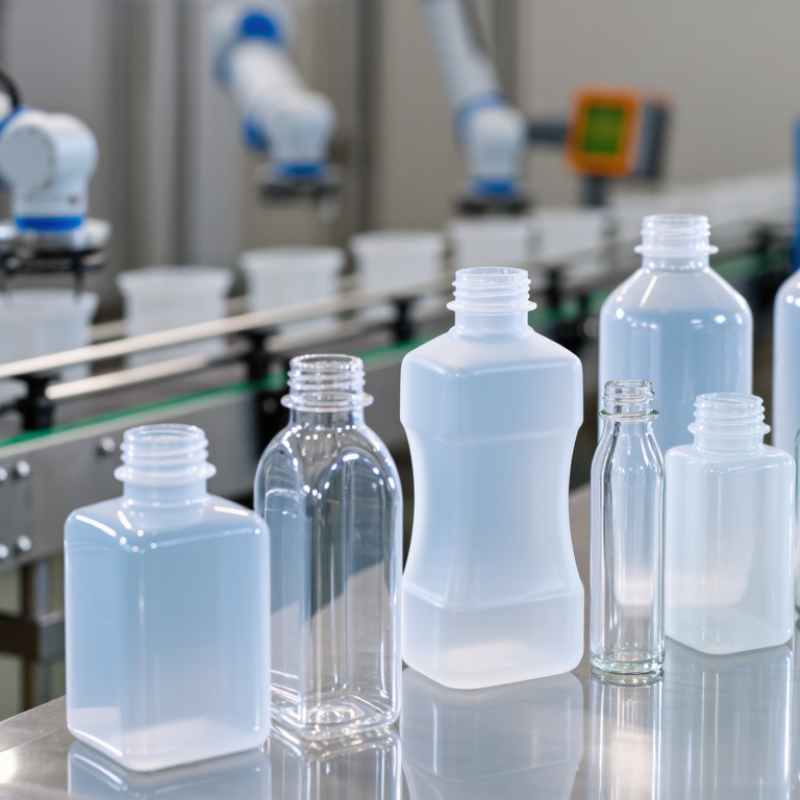
Bottle scratches rarely come from one source. In factory inspections, marks often appear after filling, conveying, washing, or packing. A bottle may leave molding equipment without defects, then develop scuffs against a guide rail minutes later. Dust can act like fine sand between touching surfaces.
The most common type is a superficial abrasion. It looks cloudy or gray under strong light. A deeper gouge removes material and may weaken thin plastic walls. Glass bottles can develop chips or star-shaped impact marks around the base and shoulder.
Plastic containers may show stress whitening, crazing, or stretched lines near corners. These signs suggest different causes and require different controls.
Temperature changes also matter. Hot filling, rapid cooling, and repeated washing can increase internal stress, especially in molded plastic. Cleaning chemicals may worsen existing marks rather than create them directly. Our first assumption is often wrong. A visible scratch may begin as a small molding line, not rough handling. Check contact points, conveyor speed, bottle spacing, and trapped particles together. A simple rub test helps, but it cannot replace microscope inspection or controlled drop testing. Record the scratch location and direction. Repeated patterns usually reveal the equipment causing them. A practical review should compare empty, filled, and packed bottles, because their resistance changes under load.
Bottle scratch resistance begins with material selection, not decorative coating. Glass offers a hard, premium surface, but its edges can chip after repeated contact. PET is lightweight and impact tolerant, yet its softer surface can show scuffs around shoulder curves. HDPE hides minor marks better because of its natural opacity. PlasticsEurope’s Plastics—The Fast Facts 2023 reported 400.3 million tonnes of global plastic production in 2022. This scale makes durable, recyclable bottle design increasingly important. UNEP’s 2023 Turning off the Tap report also identifies packaging as the largest single-use plastic application, representing about 40% of plastic waste.
Design details matter. Use rounded shoulders, recessed labels, and a stable base ring. These features reduce contact with conveyor rails and rough shelves. A textured grip can disguise light abrasion, but excessive texture may trap dust. Clear bottles need extra care. Hard-coat layers can improve surface durability, although they may affect recyclability or transparency. Test the complete bottle, including ink and coating. ASTM D4060 abrasion testing measures material loss under controlled rubbing, while ASTM D1003 evaluates haze. There is no universal pass value. Product use must define the target.
Tips: Request samples with recycled content included. Compare them after 500 conveyor cycles and three weeks of handling. Inspect shoulder edges under angled light. Small flaws become obvious there. I would not trust a single laboratory result; real handling is less polite. Keep the test method, load, and inspection photos recorded for reliable supplier comparisons.
Bottle scratch resistance often begins with the coating system, not the glass alone. In Chinese production lines, operators commonly apply clear polyurethane, acrylic, or sol-gel layers. Each option changes hardness, flexibility, gloss, and curing speed. A thin coating may look attractive but fail around shoulders and threads.
Testing should follow recognized methods. ASTM D3363 measures pencil hardness, while ISO 1518-1 evaluates scratch resistance under a controlled load. ASTM D4060 also measures abrasion loss after repeated wheel contact. A practical target is 4H or higher pencil hardness, combined with low mass loss after 1,000 abrasion cycles. These figures are useful, but they are not universal acceptance limits. Bottle shape and coating thickness still matter.
Surface preparation remains critical. Remove oil, dust, and release residues before spraying or dipping. Plasma treatment can improve adhesion on difficult surfaces. Cure the coating at a controlled temperature, then inspect edges under angled light. Small defects become obvious there. Field trials often reveal an uncomfortable fact: a harder coating is not always better. Excessive hardness can reduce flexibility and create chips during filling or transport. A balanced formulation usually performs better than the highest laboratory score. Testing should include wet handling, label contact, and repeated conveyor movement. Industry guidance from ISO and ASTM supports consistency, yet each factory should build its own data record. Manufacturing conditions vary.
China Top 10 Ways to Enhance Bottle Scratch Resistance?
Optimizing Manufacturing and Handling Processes
Scratch resistance begins with controlled manufacturing, not last-minute inspection. Use clean molds and polished contact surfaces to reduce microscopic marks during forming. Keep glass or plastic temperature stable, because uneven cooling can create weak areas. Production teams should also check conveyor guides, clamps, and transfer wheels every shift. A small metal burr can damage hundreds of bottles before anyone notices.
Tips: Reduce bottle-to-bottle contact. Set conveyor speed carefully. Remove dust from guide rails. Use soft, correctly adjusted handling parts. Record scratches by location, not only by quantity.
Packaging operations need equal attention. Avoid loose bottles touching inside cartons or during pallet movement. Proper separators can prevent rubbing, while stable stacking reduces pressure on lower layers. Operators should lift containers instead of dragging them across metal tables. This simple habit is often missed. It also deserves regular training.
Testing should reflect real handling conditions. Rub samples against packaging materials, inspect them under angled light, and compare results after transport simulation. Surface coatings may improve resistance, but poor adhesion can create misleading results. One test is not enough. Recheck performance after temperature and humidity changes. Manufacturing teams should review failed samples openly, even when the cause is inconvenient. That practical feedback improves process control and product reliability.
The chart uses a normalized engineering-priority index, with the untreated baseline set to 100. Higher values indicate stronger potential for reducing visible scratches through better material selection, forming control, surface treatment, packaging, and handling. Actual results should be verified with abrasion and scratch testing under production conditions.
China Top 10 Ways to Enhance Bottle Scratch Resistance?
Testing, Quality Control, and Ongoing Scratch Prevention
Scratch resistance begins with a repeatable test plan, not visual inspection alone. ASTM D1003 measures haze, while ASTM D4060 evaluates abrasion under controlled wheel, load, and cycle conditions. Record haze change, gloss loss, and visible marks after testing. Smithers’ 2024 packaging outlook values the global packaging market at more than one trillion dollars, making small appearance defects commercially important. Yet, market size does not replace product-specific evidence.
Quality control should examine every contact point. Check conveyor rails, star wheels, guide plates, and filling heads for burrs or trapped particles. Use clean gloves during sampling. A simple white-light inspection can reveal curved scratches that automated cameras miss. Control bottle temperature, because softer surfaces may scratch more easily during handling. Apply incoming inspection and hourly line checks. Keep results traceable by mold cavity, production shift, and packaging batch.
Prevention continues after production. Reduce bottle-to-bottle contact with suitable spacing, smoother dividers, and controlled pallet movement. Store containers away from dust, metal fragments, and excessive heat. Review reject images weekly; patterns often expose one damaged guide or unstable conveyor. Perfect prevention is unrealistic. Our assumptions can fail. A test load may not represent warehouse vibration or retail handling. Recheck conditions with real transport trials, then adjust the inspection frequency and acceptance limits. ISO 9001-based corrective-action records can help teams verify whether improvements remain effective.
| No. | Enhancement Method | Quality-Control Action | Recommended Test or Reference | Key Data to Record | Ongoing Scratch-Prevention Practice |
|---|---|---|---|---|---|
| 1 | Optimize the bottle material | Control resin or glass composition, recycled-content ratio, moisture, contamination, and forming conditions according to the selected material specification. | Material certificate review; incoming-material inspection; visual inspection under controlled lighting. | Material grade, batch number, recycled-content percentage, moisture level where applicable, and visible defect rate. | Approve only qualified material sources and quarantine lots that show abnormal surface defects or inconsistent processing behavior. |
| 2 | Improve mold and tooling condition | Polish product-contact surfaces, remove burrs, maintain correct alignment, and prevent worn tooling from transferring marks to the bottle. | Tooling inspection; surface-roughness measurement where specified; first-piece approval after maintenance. | Tool ID, maintenance date, contact-surface condition, roughness result when required, and defect observations. | Use preventive-maintenance intervals based on production cycles and inspect high-contact areas at each changeover. |
| 3 | Reduce molding and forming defects | Stabilize temperature, pressure, cooling, stretch, and cycle time to reduce stress marks, flow lines, weak areas, and uneven walls. | Process-parameter verification; dimensional inspection; polarized-light stress inspection for suitable transparent materials. | Machine settings, cycle time, wall-thickness distribution, reject rate, and stress-mark findings. | Use approved process windows, statistical process control, and documented reaction plans for drift. |
| 4 | Apply a suitable protective coating | Select a coating compatible with the bottle substrate, verify surface preparation, and control coating thickness and curing conditions. | Dry-film thickness measurement; adhesion testing using ASTM D3359 where applicable; abrasion testing using ASTM D4060 where applicable. | Coating thickness, cure conditions, adhesion classification, abrasion mass loss or cycles, and appearance after testing. | Control coating-bath condition, application speed, curing temperature, and handling time before full cure. |
| 5 | Strengthen labels, inks, and decoration | Choose abrasion-resistant decoration systems, confirm ink or label adhesion, and prevent sharp edges or raised features from becoming wear points. | Cross-hatch adhesion testing using ASTM D3359 where applicable; rub or abrasion testing based on the approved product specification. | Adhesion result, rub cycles, color change, print loss, label lifting, and surface appearance. | Allow sufficient drying or curing time and use approved packaging separators to avoid decoration-to-bottle contact. |
| 6 | Measure surface finish consistently | Define a reference appearance and measure gloss, haze, color, and visible scratches under consistent conditions. | Gloss measurement using ISO 2813 where applicable; transparency or haze measurement using ASTM D1003 where applicable. | Gloss units at the selected geometry, haze percentage, color difference, lighting condition, and operator result. | Calibrate instruments, use the same measurement geometry, and maintain approved visual standards for inspectors. |
| 7 | Use controlled scratch and abrasion testing | Compare production samples with approved references using controlled load, abrasive type, stroke or rotation speed, and test duration. | ASTM D5264 for abrasion resistance of printed materials where applicable; product-specific reciprocating or rotary scratch methods. | Applied load, abrasive material, number of cycles, scratch width or visibility, gloss change, and pass/fail result. | Do not compare results from different methods unless the test conditions and acceptance criteria are equivalent. |
| 8 | Control bottle-to-bottle contact | Review conveyor rails, star wheels, guides, chutes, pallets, dividers, and accumulation zones for hard particles and excessive contact pressure. | Line observation; contact-point audit; controlled trial at normal and maximum operating speeds. | Contact locations, line speed, accumulation time, particle contamination, scratch frequency, and defect images. | Use clean, low-friction contact materials where suitable and remove damaged guides immediately. |
| 9 | Improve packaging and transport protection | Prevent direct rubbing during palletizing, carton movement, vibration, and stacking by using correctly designed partitions, trays, sleeves, or separators. | Packaging distribution testing based on the shipment profile; vibration and compression tests using the applicable packaging specification. | Packaging configuration, stack height, vibration exposure, transit duration, damage location, and returned-defect rate. | Inspect packaging materials for dust, grit, moisture, deformation, and loss of separation during storage and shipment. |
| 10 | Establish a continuous improvement system | Track scratch defects by process stage, perform root-cause analysis, and verify corrective actions with repeat testing. | SPC, Pareto analysis, 8D or CAPA records, layered process audits, and periodic requalification testing. | Defect rate, location, shift, machine, material lot, corrective-action date, and verification result. | Set internal acceptance criteria from customer requirements and risk assessment; review trends regularly rather than relying only on final inspection. |
Note: Test methods and acceptance limits should be selected according to the bottle substrate, coating or decoration system, intended use, packaging configuration, and customer specification.
The coating system often matters more than the glass alone. Clear polyurethane, acrylic, and sol-gel layers offer different hardness, flexibility, gloss, and curing speeds. Thin coatings may fail around shoulders and threads.
Remove oil, dust, and release residues before spraying or dipping. Plasma treatment can help difficult surfaces accept the coating. Cure at a controlled temperature. Small details matter.
No. Excessive hardness may reduce flexibility and cause chips during filling or transport. A balanced coating can outperform a harder laboratory formula. This assumption needs checking.
Pencil hardness testing measures surface hardness. Controlled-load scratch testing evaluates resistance under pressure. Abrasion testing measures material loss after repeated wheel contact. Use the same method every time.
Record haze change, gloss loss, visible marks, and coating defects. A practical target may be 4H or higher pencil hardness. However, results are not universal limits.
Inspect shoulders, threads, edges, and curved surfaces under angled light. Check conveyor rails, star wheels, guide plates, and filling heads. Burrs or trapped particles can create repeated scratches.
Use incoming inspection and hourly line checks. Track results by mold cavity, production shift, and packaging batch. Clean gloves help protect samples. Do not rely on visual checks alone.
Increase spacing between bottles and use smoother dividers. Control pallet movement and protect containers from dust, metal fragments, and excessive heat. Warehouse vibration may expose weaknesses missed in the factory.
Review reject images each week and inspect every contact point. One damaged guide or unstable conveyor may explain the pattern. Corrective records help confirm whether repairs remain effective. Perfect prevention is unrealistic.
This guide explains the key methods to enhance the scratch resistance of bottle surfaces by first identifying common causes, such as friction during transportation, contact with hard objects, improper stacking, and unsuitable cleaning methods. It compares how different materials, wall thicknesses, shapes, and surface finishes influence durability, helping manufacturers select bottle structures that can better withstand daily handling while maintaining appearance and functionality.
The article also discusses protective coatings and surface treatments that improve hardness, smoothness, and resistance to abrasion. In addition, it highlights the importance of optimizing molding, filling, packaging, storage, and transportation processes to reduce unnecessary contact and impact. Regular testing, including abrasion, friction, drop, and visual inspections, supports consistent quality control. By combining appropriate materials, effective treatments, careful production management, and ongoing monitoring, manufacturers can reduce visible damage, extend bottle service life, and maintain a reliable product appearance.
